
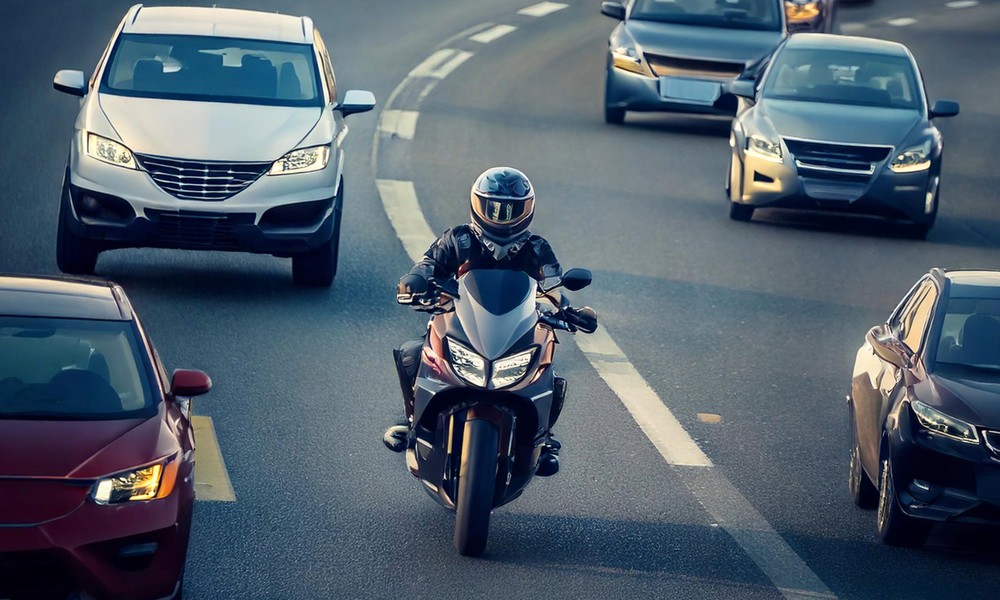
Saturday afternoon on Rancho California Road. Tasting room traffic backed up to the next driveway, an SUV swings left without signaling, and the rider threading the stripe between cars goes down. By the time Attorney Dustin gets the call, the rider is already worried about the same thing every motorcyclist worries about after a wreck: nobody is going to believe me because I was lane-splitting.
That fear is the single most consistent thing about motorcycle cases coming out of Temecula wine country. It is also, in most cases, wrong. California law is on the rider’s side, and lane-splitting cases are often more winnable than riders believe when they leave the emergency room.
Lane-Splitting Is Legal in California, Period
California became the first and only state to explicitly legalize lane-splitting when Assembly Bill 51 was signed in 2016. The rule lives in Vehicle Code section 21658.1, which defines lane-splitting as driving a motorcycle between rows of stopped or moving vehicles in the same lane, including on divided and undivided streets, roads, and highways. The statute also authorizes the California Highway Patrol to develop educational safety guidelines.
That last piece is where adjusters try to muddy the water. CHP guidance recommends traveling no more than about 10 miles per hour faster than surrounding traffic, avoiding splitting at higher freeway speeds, and watching for wide vehicles, large trucks, and exit ramps. None of those guidelines turn lane-splitting illegal. They are factors that may inform comparative fault percentages, not a backdoor way to argue the rider broke the law.
When an adjuster claims otherwise, and many do, that is usually the first sign the claim is being undervalued. Pushing back with the actual statute and the CHP guidelines, in writing, often changes the tone of the conversation quickly.
Why Wine Country Routes Produce a Specific Kind of Crash
The roads that make Temecula famous for weekend rides also produce a recurring set of crash patterns. Rancho California Road, De Portola Road, Anza Road, Glen Oaks Road, and the country routes between Pauba and Calle Contento funnel a heavy mix of locals, tourists, limousines, and party buses past dozens of winery driveways with limited sightlines.
The crashes that follow tend to fall into familiar categories:
- Left-turn collisions where a driver cuts across the rider’s path into a winery driveway
- Rear-end impacts in slow tasting-room traffic, often with the rider lane-splitting at the moment of impact
- Cross-center-line crashes on curves where a driver drifts wide
- Driveway pull-outs where a vehicle leaves a winery and fails to see oncoming motorcycle traffic
In each scenario, the rider is rarely the proximate cause. The Hurt Report, the most cited study of motorcycle crash causation in the country, concluded that the other vehicle’s driver violated the motorcycle’s right of way in roughly two-thirds of multi-vehicle crashes. More recent NHTSA and FHWA data tells essentially the same story.
How Insurance Companies Try to Shift the Blame Anyway
Even with a clear statute and decades of crash data, riders run into a predictable set of defenses. Carriers know juries can carry bias against motorcyclists, and the entire negotiating posture is built to exploit it.
The arguments that show up most often in adjuster letters:
- The rider was lane-splitting at unsafe speed, even when telemetry, traffic camera footage, and witnesses show otherwise
- The rider was not visible, framing the crash as a reasonable mistake by the driver rather than a failure to look
- The rider’s helmet or gear was inadequate, an attempt to invoke California Vehicle Code section 27803, the universal helmet law, to reduce damages
- The rider had prior injuries, the pre-existing condition defense, especially when neck and back injuries appear later
California is a pure comparative negligence state, which means a rider can recover even if assigned a substantial percentage of fault. That percentage becomes the leverage point, and it is decided by whoever builds the better evidentiary record. Helmet cam footage, GoPro video, dashcams from nearby vehicles, CHP MAIT reports in serious cases, and prompt scene investigation all matter more in motorcycle claims than in almost any other category of personal injury work.
What Riders Should Do Before Calling an Adjuster
The first hours after a wine country crash shape the case more than most riders realize. A handful of steps consistently move outcomes:
- Decline the recorded statement from the other driver’s carrier. There is no legal obligation in California to give one to a third-party insurer.
- Preserve every video. Helmet cam, GoPro, dashcam, and any footage from nearby winery security cameras. Wineries overwrite their recordings on rolling cycles, often within a week.
- Photograph the gear, including the helmet, even if it looks intact. Compressed liner foam tells part of the medical story of a concussion later.
- Get medical evaluation the same day. Adrenaline masks soft tissue and head injury symptoms, and gaps in treatment are the most common reason motorcycle claims are devalued.
- Document the scene, or send someone back to do it. Skid marks, debris fields, lighting, and signage can change within days.
Why Riders Call Attorney Dustin for These Cases
Motorcycle claims reward attorneys who actually understand the bike. Knowing why a rider counter-steered through a curve, why a left-turn driver’s “I never saw him” is often a failure-to-look rather than an excuse, and why a helmet’s gel liner compressed in a specific spot supports a concussion diagnosis are the details that change settlement value.
Attorney Dustin handles motorcycle injury claims on contingency, with a free initial consultation. That includes wine country crashes on Rancho California Road, De Portola, the Highway 79 corridor, and the I-15 stretches running through Temecula and Murrieta. The lane-splitting fear that keeps so many riders from picking up the phone is, more often than not, the weakest piece of the carrier’s defense. The right next move is a call, not silence, and not a recorded statement to the other driver’s insurance company.